


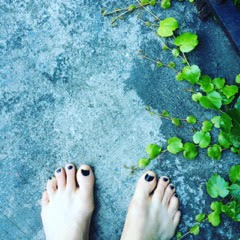
 Meditation is a process of developing greater awareness, and we are continuously discovering who and what we are. We meet ourselves wherever we are in the moment. That might be a bit scary or a bit boring – but be brave the challenge is not to let this discomfort take over but to relax into how things are. Bring your awareness back to the moment rather than thoughts or feelings and do so without judgment. After a while the discomfort slips away in to a natural rhythm.
Contrary to popular imagery, we do not have to sit in full lotus position or cross-legged on the floor to meditate. In fact traditional Buddhist teachings identify four meditation postures: sitting, walking, standing, and lying down. All four are valid ways of cultivating a calm and clear mindfulness of the present moment. We can develop this awareness in many different ways.
We can meditate ‘in action’ with a walking meditation. When we are feeling tired or sluggish this style of meditation can be a good alternative to sitting or lying down. When we practice walking meditation we are using the physical and mental and experiences of walking to develop our greater awareness. We observe in a non-judgmental way. We can be mindful of our breath, our body in motion, the sensation of muscles working, of our feet touching the ground. We can appreciate our experience. When we do this we are expanding our perspective and creating mental flexibility and healthy self-identity. No matter what is going on in our lives we can tune in to this experience, in this moment, and allow it to bring joy. We are cultivating a discipline to appreciate and relax.
You can work on your walking meditation in the comfort of your own home – literally walking from one side of the room to the other. When you come to the end of your path, come to a stop, turn around as mindfully as you have been stepping, stop again, and then begin again, back and forth. Keep your eyes cast down or in a semi-half-closed hold without looking at anything in particular.
Walk back and forward on a single path as opposed to wandering around because to do this the mind would need to engage to negotiate your path, around a chair, over a pillow etc. With the back and forward there is no problem solving involved –that component is taken out.
Walk more slowly than usual so that you can really examine the sensation of each movement, the leaning to one side, the tension in the muscles as they engage, the lifting of the leg, the moving forward, the placement of the foot, the connection to the ground. Be interested, examine the sensation.
There is no “right” way to experience. Just explore the experience for yourself. Let go of judgment, and when the mind wanders off, as it tends to do, simply notice that it has, and then bring it back to the sensations of the activity. You might also find it helpful to label what you want the mind to observe for example ‘lifting, moving, placing….” Try to let everything else go, give yourself permission to do this.
You can train your mind to be present any time you walk, maybe you incorporate it into your day at the office by mindfully walking to the water cooler, or to the bathroom. Or you can take it out into your day, walk a block mindfully. Obviously in this circumstance you would increase the speed slightly but the concept remains the same.
There is a wonderful Buddhist teaching that reads:
Again, monks when walking, one knows “I am walking;” when standing, one knows “I am standing;” when sitting one knows “I am sitting;” when lying down “I am lying down;” or one knows accordingly however one’s body is disposed.
This is such a simple concept, but so profound and powerful. It grounds us in the awareness of the body instead of being carried away with thoughts.
How often are we doing something without even being aware we are? I think about this when I see us all rushing. Have you ever noticed that rushing has little to do with speed or efficiency? It is more to do with a state of anticipation, wanting, energetically toppling forward. To notice this can be a gift, it can cut through the state of mind in rushing and maybe cause you to notice there is actually a desire for a more meditative state, a little more space in the mind.
When walking just walk, settle into that moment.
Brogan Ganley is a Mindfulness and Meditation teacher, she also specializes in helping people relieve their anxiety, stress and pain, as well as those receiving cancer care. Contact Element Healing for a session.