


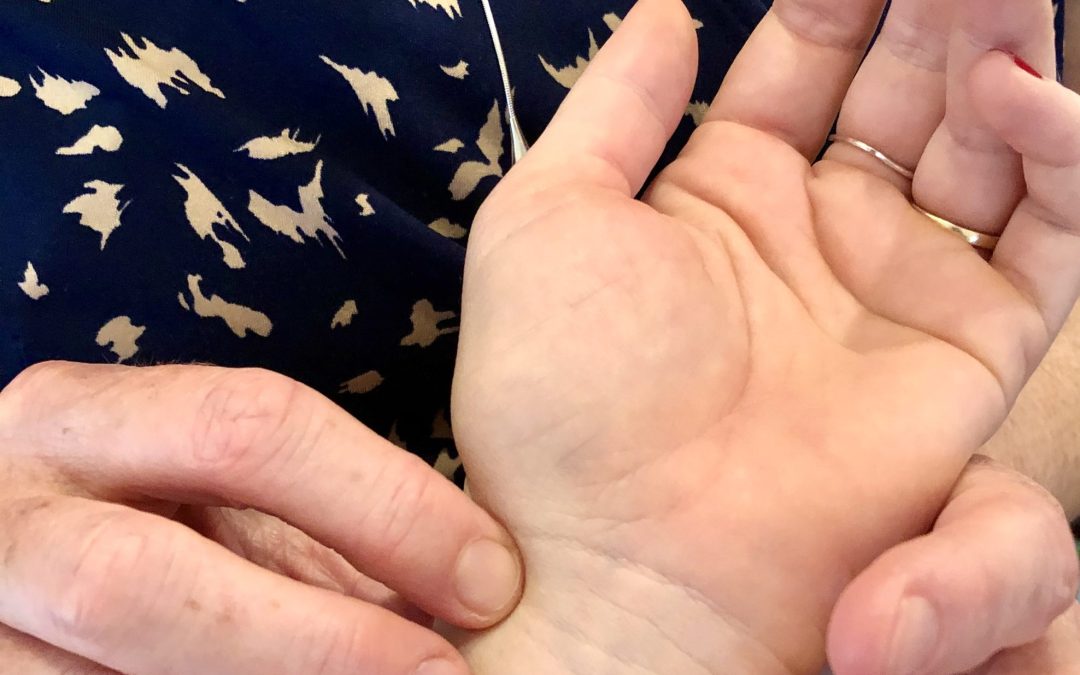

In Traditional Chinese Medicine (TCM), pulse palpation—an examination in which a practitioner takes a patient’s pulse—is a key component to diagnosing imbalances and viewing a person’s overall health. Believe it or not, there are twenty-eight different qualities of pulses that can be felt on the wrists. Each quality gives the practitioner different information. The goal of pulse diagnosis is to determine the state of the internal energy and organ systems that allow our bodies to either thrive and function, or weaken and decline. A pulse can indicate the cause of illness, and what steps to take to resolve the situation, as well as the prognosis for recovery.
Different pulse positions on each wrist correspond to different organs in the body. Three fingers (the index, middle and ring finger) are placed over the radial artery of each wrist. Each finger rests on a different part of the pulse—front, middle, and rear. With each position lie three levels—superficial, middle, and deep. The pulses and three positions on the right wrist correspond to the lung and large intestine, stomach and spleen, and the kidney (yang) energies, respectively. The pulses and three positions on the left wrist correspond to the heart and small intestine, liver and gallbladder, and the kidney (yin) energies.
Besides pulse rate, there are four pulse attributes that are equally important in pulse diagnosis—pulse width, length, depth, and quality. The pulse width is indicative of how much blood is flowing through the vessels. A woman who just gave birth could have a much thinner width because of blood loss and depletion. Pulse length represents the strength and balance of blood and energy, measuring whether there is enough blood and energy to push the blood adequately through the vessels. Pulse depth indicates the different depths of energy (qi) in the body. A superficial pulse tells a practitioner about the skin and “wei qi,” or protective energy; the middle level corresponds to the internal organs; and the deep level represents our root energy and energy reserves. Pulse quality is the actual sensation of the pulse— a pulse can feel slippery like a pearl sliding down the three positions, or choppy like a caterpillar chewing on a leaf. All four of these attributes allow the practitioner to diagnose and treat diseases and pathogenic invasions, as well as identify weaknesses, excesses or imbalances.
A normal pulse indicates good heart energy and circulation, with regular beats that are calm, smooth, and moderately soft in quality. The deeper position (kidney), representing the root energy, should be easily felt upon palpation. These pulse qualities, combined, indicate good health.
Come into Element and let us help you check out the state of your pulse to help you be as healthy as possible with massage, acupuncture, or any of our other treatments.

Acupuncturist, herbalist, Maya abdominal practitioner, and reflexologist Christina Morris is the founder of Element Natural Healing Arts. Writing about health and wellness gives her an outlet to express her care and concern for her beloved community. She believes everyone can achieve better health and happiness–emotionally, physically, mentally, and spiritually.