


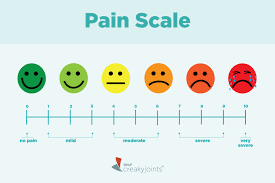
Pain: annoying, distracting, uncomfortable, achy, sharp, stabbing, horrible, unbearable. Lots of words describe pain, but it’s not always easy to pinpoint with accuracy.
Using a pain scale to determine the level of pain, rather than a string of adjectives that can be extremely relative, can be useful in trying to treat it.
In my practice, I use a 1-10 pain scale. For example: someone can comes into my office initially with low back pain, estimating the pain level at 7. After a second treatment, she says the pain level is a 5. Pain is uncomfortable at any level, and nobody wants even a little pain. In conversation, the patient mentions that she doesn’t notice any real change. Yet she’s actually lowered the pain level, on the pain scale, indicating that there is some progress. So using a numeric gauge helps to show that she’s going in the right direction, even if she’s still distracted by the pain.
It can be hard, slow, erratic and frustrating to track pain conditions, adjust to the pain levels ebbing and flowing, before they gradually decrease with treatment. Pain scales can help us monitor this, so that we can provide the best care. The 1-10 pain scale can sometimes seem confusing to patients, who may not understand what the different numbers can represent and how they help.
Here’s a brief description.
1 is the lowest pain and 10 is the highest pain.
0 Pain free, no pain.
1. Minimal pain, hardly noticeable. Most of the time, you are not aware of the pain.
2. Mild pain, only present when you focus your attention on it.
3. Discomfort pain, bothers the person some, but can still be ignored.
4. Moderate pain, constantly aware, but can still function for daily activities.
5. Distracting pain, almost continual pain most of the time that inhibits activities.
6. Distressing pain, pervasive and prohibiting many activities.
7. Unmanageable pain, constant, unrelenting pain, prohibiting most activities.
8. Intense pain, so vivid that is starting to make it harder to think, focus, communicate.
9. Severe pain, extreme pain that makes it hard to talk or move.
10. Crippling pain, completely incapacitated.
The pain scale is a subjective, but nonetheless productive and quantitative tool for practitioners. It helps us understand our patient’s pain, progress, and process.
Contributor
Acupuncturist, herbalist, Maya abdominal practitioner, and reflexologist Christina Morris is the founder of Element Natural Healing Arts. Writing about health and wellness gives her an outlet to express her care and concern for her beloved community. She believes everyone can achieve better health and happiness–emotionally, physically, mentally, and spiritually.