


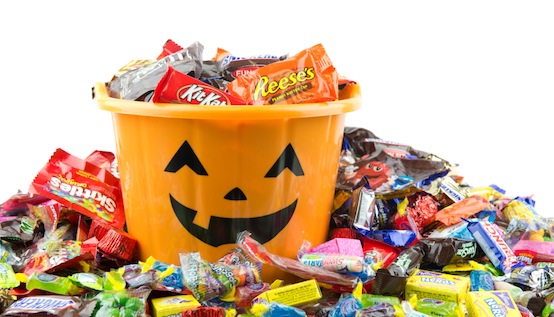
Halloween is here and there is no doubt that the temptation to have a treat is lurking at every turn! Sugar is addictive and, for some people, starting down that path is a dangerous journey. The effects of sugar, as a product of refining, is often compared to drugs, as quoted in a popular dietary classic, Sugar Blues by William Dufty, released in 1975.
“Heroin is nothing but a chemical. They take the juice of the poppy and they refine it into opium and then they refine it to morphine and finally to heroin. Sugar is nothing but a chemical. They take the juice of the cane or the beet and then refine it to molasses and then they refine it to brown sugar and finally to strange white crystals.”
There are many different kinds of sugar. Finding hidden sugar additives can be difficult, as food labeling is not always transparent. Here are sixty-three common sugar and sweetener names used on food labels, so that you know what to look for:
- Agave nectar
- Barbados sugar
- Barley malt
- Barley malt syrup
- Beet sugar
- Brown sugar
- Buttered syrup
- Cane juice
- Cane juice crystals
- Cane sugar
- Caramel
- Carob syrup
- Castor sugar
- Coconut palm sugar
- Coconut sugar
- Confectioner’s sugar
- Corn sweetener
- Corn syrup
- Corn syrup solids
- Date sugar
- Dehydrated cane juice
- Demerara sugar
- Dextrin
- Dextrose
- Evaporated cane juice
- Free-flowing brown sugars
- Fructose
- Fruit juice
- Fruit juice concentrate
- Glucose
- Glucose solids
- Golden sugar
- Golden syrup
- Grape sugar
- HFCS (high-fructose corn syrup)
- Honey
- Icing sugar
- Invert sugar
- Luo Han Guo
- Malt syrup
- Maltodextrin
- Maltol
- Maltose
- Mannose
- Maple syrup
- Molasses
- Muscovado
- Palm sugar
- Panocha
- Powdered sugar
- Raw sugar
- Refiner’s syrup
- Rice syrup
- Saccharose
- Sorghum syrup
- Stevia
- Sucrose
- Sugar (granulated)
- Sweet sorghum
- Syrup
- Treacle
- Turbinado sugar
- Yellow sugar
Sugar has its place in a person’s diet and is important for the body to function properly, but too much of anything is never a good thing. The more processed the sugar the more dangerous it can be. Many health and diet experts warn that excess sugar consumption can lead to disease and complications, including diabetes, obesity, liver damage, decreased HDL (“good” cholesterol), increased LDL (“bad” cholesterol), elevated triglycerides, high blood pressure, memory issues, and raised levels of uric acid (a risk factor for heart and kidney disease). Sugar also contributes to tooth decay.
The American Heart Association reports that most Americans consume an average of 22 grams of added sugar (meaning the sweeteners and syrups that are added to foods during processing and preparation) per day. This is much higher than the recommended 6 teaspoons (24 grams) for women and 9 teaspoons (36 grams) for men.
During this Halloween and throughout the upcoming holiday season, be aware of your sugar intake. Notice how it makes you feel: tired, irritable, anxious, bloated, generally uncomfortable. It’s ok to walk away from the temptation of sweets, because you will feel much better in the long run.
Here’s a very interesting video on how much sugar is in soft drinks and more interesting sweet facts:
http://easyscienceforkids.com/how-much-sugar-is-in-soda-video-for-kids/
Contributor
Acupuncturist, herbalist, Maya abdominal practitioner, and reflexologist Christina Morris is the founder of Element Natural Healing Arts. Writing about health and wellness gives her an outlet to express her care and concern for her beloved community. She believes everyone can achieve better health and happiness–emotionally, physically, mentally, and spiritually.